Showing posts with label Deep Thoughts By Camryn. Show all posts

5.17.2016

THE COLLEGE CHAPTER

Okay. One more post about college and then I swear I'll (maybe) never write about it again. But I ain't gonna make no promises, yo (This is the title of my upcoming rap album). Prepare for a lot of rambling thoughts and reflections and feelings and subtle undercurrents of denial (because WHAT THE HECK HOW AM I A COLLEGE GRADUATE WHEN DID THAT HAPPEN I FEEL WEIRD). 

During my last semester I was in a Graphic Design class. An actual, real design class where we used Adobe programs and made logos and said really long winded, conceptual things that never needed to be said about circles and squares. I find it very interesting that I wound up taking this class in my final semester of college as it's a very narratively perfect bookend to my undergraduate career. I started here, and I ended here.

When I first got to college, all wide-eyed and excited and full of confidence, I decided fairly quickly that I was going to major in Graphic Design. People always told me I would be so good at it, I loved doing creative things, and anything art-related was a big chunk of my list of creative endeavors. When I was little my favorite thing to do was draw. My mom says I would end a marathon session of drawing with hands completely black from the ink of my favorite Crayola markers. Creating things had always made me so happy, so it made sense that I would pursue this path. So I enrolled in the pre-requisite design and drawing classes, and I did really well. My professors told me I was definitely going to get into the program. They gave me grades that reflected that. But, a year after I started and had applied, my application was rejected, and I had to decide between waiting a few months and applying one more time, or choosing a new major and leaving my artistic aspirations behind. 

The funny thing about this transition period was that I wasn't really that upset about not getting into the program. All along I think I knew that something was off--I didn't really belong there. Looking back, I think I subconsciously knew I would be an English major all along--I started with an English minor, for goodness sakes--and was just fighting it because I thought the art program would be easier. And it's true—the art classes I took were a lot easier. And I would also have to take two years of a language if I pursued an English degree, and I was a gigantic chicken and thought that it would be too difficult. But, after a lot of thought and experiences happened at once, it was one of the easiest decisions I ever made. I remembered how much I loved writing research papers in high school, even though they took a lot of effort. I remembered how much I loved creative writing activities in elementary school, and a certain story I wrote about a magic carrot. I remembered the day I walked into my English class near the end of my senior year and a school counselor I rarely talked to was walking out and he stopped, looked at me, and said with all seriousness, "You should be an English major," before walking away without another word.  I remembered how invigorated and inspired I felt in every English class I'd ever taken. And it was obvious—the English program was where I belonged. 

But I kept graphic design as a minor, and had to squeeze the introductory course I would have taken had I originally gotten into the program in my last semester in order to complete it. And honestly, I really loved it. But standing where I am four years after I began my college experience, I can see that even though I enjoy it and am good at it, I wouldn't have fit in there and I wouldn't have been truly happy there. I could still see that something felt off. So I am extremely grateful that I ended up where I needed to be, and had this realization once again at the end of this very fitting, very cohesive plot of this chapter in my life. And what an interesting narrative this college chapter has been. 

I find it fascinating that we all create narrative arcs in our own lives. As if our lives are already books, as if WE are books. (And Milton would argue that books contain the essence and life of the person who wrote them--and to destroy a book is as bad as killing a man. But I digress.) We use stories and narrative to shape our disparate experiences into meaning, which is one of the reasons I am so interested in stories and their power to affect people. We are drawn to them because they are how we understand ourselves. And in these past four years of my life, all of the mundane, routine days going to classes and working and reading and completing homework, now, at the end, have formed quite the story. It really has all of the elements of a heroic sort of fairy tale:

A girl, who became a legal adult the day she traveled to a place hundreds of miles away from where she had lived her whole life, found herself in a place where she knew no one. She was a stranger in this foreign place. She struggled and cried. But she realized she was not alone in her feelings, and with the support of newfound friends and family she came into her own. Everything was going well, and she thought she knew which path she should walk down, but then halfway through her time in this place she came to a dead end and wondered where she would go instead. And then one opened up to her view, and she realized a longing to go down this path was within her from the start. Along the way, there were like-minded people on that path who she grew to love. There were great, master teachers who inspired her mind and directed her skills. There were villains who didn't want her to succeed, many frogs, a charming prince, a few dragons blowing fire her way, and a final test in the end that required her to do something far outside of her comfort zone to accomplish what she previously thought was beyond her. And then, before she knew it, she emerged from the maze victorious, ready to search for her next path in life. And with the flip of a page, she began the next chapter. 

At least, that's one way to construct the narrative.

7.15.2015

CAN WE PLEASE BE REAL ABOUT BEING "REAL?"

The thoughts I'm about to attempt to communicate have been swirling around in my head for a while now, years maybe—little wisps of thought that bothered me, floating around sporadically as they came. I would hear a news story or read an article or see a post on social media and I knew that somewhere in my brain there was something I wanted to say about them all, but I couldn't quite articulate what that was. So I went on observing, all the while growing more and more bothered by the fact that my thoughts on these matters wouldn't come together. 

Until today, when I exploded on my husband (metaphorically) in the car about how ridiculous something I read on the internet was. (I guess sometimes it takes a little raging and ranting for thoughts to come rushing together.) 

(At least for me.)

But before I get to them, I'd like to say first that this isn't meant to be condescending. I used to be on the other side of this issue, and I've harped on technology and social media hundreds of times in the past--and I still do. Quite a bit, actually. (To be honest—I think it's really stupid.) But there's a certain type of harping going on in society that is becoming so prevalent, I worry that it's becoming unintentionally destructive. Allow me to explain.

Everyone, lately, is obsessed with being "real." Women are encouraged, or rather pressured, to post pictures of themselves online with no makeup on. Women who like to look put together out in public in lieu of donning sweatpants to class are labeled as "fake", "insecure", or "trying too hard." People who predominantly post happy things and aesthetically-pleasing pictures on social media are scorned for "portraying their lives as perfect" and "not being real." 

This obsession grew out of and is fed by news channels and celebrities and marketing campaigns that report that when people appear to be only happy on social media, it damages other people's self confidence. It can even make others depressed to see you smiling. 

But why is this such a revelation to people? Why is anyone surprised? Why was there an article in my school's newspaper last month about a new study that apparently just discovered people can feel sad, depressed, or lonely when they look at others' social media accounts? It's common sense—I mean, I'd feel pretty lonely too if all the time I spent interacting socially was with my face twelve inches away from a screen, sitting in a dark room eating buckets of Goldfish and wondering why my hair doesn't look as good as so-and-so's and why I don't really know any of my so-called "friends." Hasn't everyone known for eons that a person cloistered up in their house might be a little sad? And is it really the internet that has all of a sudden made people compare themselves to other people? I don't think so.

If you're getting depressed by looking at everyone's "seemingly" perfect lives on social media, then stop following them or looking at them—just like you would in real life if something upset you. You're not forced to immerse yourself in things that fill your life with negativity. You can choose what you surround yourself with—you're in control. If it's making you miserable, cut it out of your life. Don't expect other people to post a picture of themselves crying with the caption "I'm really not happy ever! I never should have gone to culinary school! Worst decision of my life!" to make you feel better about yourself.

That's employing a philosophy about happiness that everyone knows doesn't work—thinking you can feel better about yourself by seeing other people failing or feeling upset or looking bad. You know, building yourself up by watching others being torn down. Why should seeing a post on Facebook about your "friend" having a rough day and failing a math test make you feel better about yourself? Or happy? 

But Camryn, you say, it's not like we hate people! We just like to know that other people are struggling to be reminded that it's okay that we sometimes struggle, too. 

Well that's all well and good, but that's the thing about all of this that bothers me:


Don't we all know that everyone is human?

Don't we all know that everyone isn't perfect?

Don't we all know that everyone isn't happy all the time?


I thought that was the case—I mean come on, we hear it preached by society enough. But honestly, I'm not sure we do. If we truly knew this, then we wouldn't let ourselves be outraged by the fact that Amanda retouches her blemishes on her pictures, or that David only writes about the positive things going on in his life, or that Jessica takes adorable, well-composed photographs of her family and likes to share them with everyone.

We, being realistic and rational, would realize that Amanda is probably worried about her skin every time she steps out the door, that David could have gotten a bad test score for every good one he announces, and that Jessica likely has days where she crashes onto the couch in tears feeling completely overwhelmed by her role as a mother of three little ones.

Because we have experienced it too. Sadness. And, well, I wasn't expecting to go here but here I am: if you've seen Inside Out, you know that sadness, and being vulnerable in that sadness, is pretty darn important to our emotional health. But people deal with their hardships and feelings in different ways. Some people really like sharing these feelings with others by talking about them online. And if that works for them and others in their situation, that's great. Wonderful, even. But other people? Some of us feel most comfortable privately talking about our rough patches or disappointments with our parents or a friend. Some of us would rather not share our makeup-less moments with the world. And we shouldn't condemn these people for appearing "perfect" online because of that and not being "real." That's how this redefinition of "real" in our society can actually turn destructive—when people are being pressured to share all of their dirty laundry online for everyone to see. Do we really need to know every sad detail about someone's life in order to believe he or she is a "real" person? Is everyone obligated to share that simply because they have a Facebook account? No. And quite frankly, not everyone needs to see that, and not everyone is going to be as gentle or kind with that information as they should be. And to be honest, most people don't want to see it. Don't believe me? 

Exhibit A: No one enjoys being friends with the people on Facebook that always post sad things. I can't begin to count how many times I've heard people talk about how much that annoys them or brings them down. (Check out Slide 7 here, or this article if you still don't understand what I'm talking about. I would advise you to pay attention to the last few paragraphs. Ahem.) People often complain about those who "overshare" on social media. Well, then, I have to ask, where's the line between being "real" and "oversharing?" 

Exactly.

Is it really so weird that people want to present themselves well online? And is it really so bad? We don't go to job interviews in our pajamas, carrying our favorite blanket. We don't go on a first date with dripping wet hair and head-gear gracing our face. We don't meet our future in-laws and immediately disclose every personal issue we've had in the past month. We try to be our best! We try to look like the normal, functioning human being we typically are but sometimes struggle to be! And no one ever says people who try to appear their best in these situations aren't "real." So why can't this common sense translate over to the internet? Why must we get so outraged or perplexed by the fact that people want to look good, or talk about their successes, or put their best foot forward in the virtual world just like they do in real life? Why doesn't this make sense to people? 

Do we all have to post one depressing, unsightly, or otherwise down-trodden thing on social media for every happy, uplifting, or beautiful thing? Would that end this "problem" everyone can't seem to get over? Would it stop making people compare themselves to others or feel sad when they go online? 

Do I need to share with the internet every time my husband and I get in an argument, every time I feel useless and unmotivated, or every time I don't do the best on a homework assignment? No. But I would hope that anyone who reads this blog realizes that I'm not some perfect robot woman because my writing lacks those details. I would hope that you would use that wonderful brain you were bestowed with to remember, even if the signs aren't there, that no one is perfect. We say that about celebrities all the time—we enjoy realizing that they're people too. If you can understand that the people whose bodies are photoshopped and expertly styled, with pockets bursting with money still aren't always happy, then geez—you should certainly be able to do the same with anyone else on your social media news feed.

No one should have to post pictures of themselves without makeup on to feel "real." No one should have to feel bad when they choose to post about positive things that happen in their lives. And no one should have to post every minuscule thing that happens to them— good and bad—to let people know that they're "real" and that everyone struggles and everyone has rough days. 

The same thing goes with real life—actual, real life.

The internet has nothing to do with it. 

4.20.2015

WORDS, WORDS, WORDS

A couple semesters ago in a class dedicated to studying the early inhabitants of the British Isles, we learned that the Celts considered words to be a sort of magic. Ogham stones, bearing the marks of their primitive language, were never even used for writing down stories because of the magical power they believed words possessed. I’ve been thinking about this a lot lately. Yes, we might not be Goidelic Celtic pagans who believe in morally ambiguous mythical beings you can interact with in liminal spaces, but the magic is still there today.

But really, though.

Sometimes I think we may as well all be wizards and witches, because words—all the words we use every day—have power. We don’t even need a wand, and we can make the same things occur. You might not be able to levitate a person, but you can elevate their spirits. You might not be able to inflict physical damage with the flick of a wand, but even one word can cause emotional pain that’s even worse. But you can actually put a person to sleep with words. I’ve experienced it in class before, and that’s some real magic right there.

The study of English is the study of words, and the ideas and truths that are shaped when words are strung together—ideas and truths that have resonated with mankind since the Epic of Gilgamesh was carved in cuneiform on clay tablets. That’s why I love my English classes—because I love digging for truth. It lies at the core of every poem, every story worth reading that has ever been written. That’s what everyone writes about, what everyone writes for. To find the truth, to wrestle with truth, to share the truth as they see it. And the only medium they can use is words. That’s it. And it fascinates me.

Sometimes when I begin to answer a text message, my mind is boggled with the millions of ways I could respond—the near-infinite treasure trove of words at my fingertips. The same feeling often comes when I begin to write a research paper or respond to someone in conversation. There are so many words I could use, so many different ways to convey the same idea, the same truth. It’s kind of amazing. Words have so much power—for good or for evil.

And I don’t think people realize this.

It pains me to read comments, articles, blogs, and conversations on the internet that are filled with hate, written by people who, because of the anonymity of the internet, choose to use destructive words because they aren’t face to face with the people they aim to tear down. It honestly makes me kind of sick—you have the power to uplift and influence the lives of others positively, simply by the words you use. If you’re filling your respective corner of the internet or the corners of others with hurtful words, you’re choosing to misuse your gift of language. And it makes me sad to see it. You have so many words to choose from. Think about the power behind the ones you use before you spread evil instead of good. Do you really want to be that kind of person?

The more I read and study the powerful writing of the greats that have come before me (just read “The Love Song of J. Alfred Prufrock” out loud and tell me you don’t feel some magic), the more I desire to construct my words in a beautiful way—the more I long to share truth and uplift those around me. All I have are words, and as long as I’m living I’m going to use their power for good.

You have over a million words to choose from.

Please choose the good ones.

5.14.2014

ON IMPRESSIONISM, KETCHUP, AND THE WAY WE LOOK AT PEOPLE

As I sit here on my couch and simultaneously contemplate the meaning of life and the latest episode of Dancing With the Stars, I think it's high time that I start taking this blog thing a little more seriously. I've been neglecting it. It's sad. It's gathered dust. AND IT DESERVES TO BE TAKEN CARE OF. 

Like a baby. Or...some other dusty thing.

Before I begin, I would like to clarify that while I haven't been writing anything in this lovely little corner of the internet for a few months, that doesn't mean I simply had nothing to write about. No, that was certainly not the case. I actually had a lot of ideas. I mean, I thought of, like, at least more than three things in the last few months...I think. So now that school is out and I have a lot more time on my hands and a whole lot less #responsibility, I'm going to play "ketchup" on here and write everything I've been meaning to for months.

(Enjoy this picture of a ketchup bottle reacting to the news that I'm writing again, and pardon the sad, sad pun I just made regarding the contents of his bottle.)
 
Anywho, back in February I had an experience, or rather a group of experiences one day that I wanted to write about. It began in my memoir-writing class.

In this class, the objective was for each of us to compose six short memoirs about our lives that we would somehow weave together under a sort of theme and turn in at the end of the semester. We were split into groups of five to share our work with early on, but one day our professor jumbled everyone up so we were with people we'd never shared anything with before. And the result was incredibly thought-provoking to me.

Typically when you meet people in a social setting, especially in college classes, all you find out about them the first time you converse are their names, where they're from, what they're studying, and pretty much anything else you can think of that is not very informative at all. It's the surface questions, the things we ask to "get to know people" when they don't actually help you get to know them at all. Learning that Sally from St. George, Utah is studying Elementary Education is just going to allow you to stereotype her and not even consider the other facets of her that make her who she is. We look at these broad facts and assume we know the details on an almost daily basis.

But in this class, it was entirely different. As I sat in that cluster of desks with four complete strangers whom I had never spoken to, we got to know each other on a completely different level. I learned that the older woman in our group had struggled with self-image issues her whole life, that the shy, reserved guy sitting across from me was once mugged at knifepoint while serving an LDS mission, and that the girl to my left almost killed herself overdosing on sleeping pills a few years ago. The complex, intimate details of these people's lives, the things that affect them and make them who they truly are were what I was privileged to see. That's how I got to know them. There were no trite, so-where-are-you-from discussions, no discussions of majors and minors and school. I walked away from class that day dwelling on the information we had shared with one another. Fifty minutes before that they had been complete strangers to me, and now I understood them on a deep, intimate level—a level I normally don't reach with new acquaintances for months. It was a strange experience.

After class I walked to the museum on campus in order to complete an Art History assignment. We had to choose a painting and analyze practically everything about it, so I took my time wandering around and looking for the perfect piece to write about. After a while I found myself lingering around the impressionist paintings and admiring the skillful technique artists use to create them—from far away, impressionist paintings appear to create a full scene rich with detail and easily discernible to the eye. But if you get up close, what you thought were obvious objects and landscapes grow muddled and confusing. You realize that the paintings are crafted by indecipherable strokes and blends of colors, and what you thought were flowers were nothing more than scattered, messy dabs of paint. You can't just walk past an impressionist painting and assume that you're truly seeing it—truly understanding it. You have to spend the extra time to get closer to it in order to appreciate what the artist has created. I found this illusion fascinating.

On the way back to my apartment, the sun setting and the majority of students heading home just as I was, I subconsciously devoted my attention to simply observing the people I passed on campus, noting their differences and wondering about their lives. What were their plans for the evening? Why were they here? Did they house secrets just as dark as some of those in my memoir workshop group? And all of a sudden all three of these events merged together in my head in a clear moment of understanding that took me off guard.

We are impressionist paintings. Each of us. From a distance, people look at us and categorize us into the neat, tidy files in their brains that exist to help them make sense of the world. We all do this, whether we like it or not: "Tool," "The Former Cheerleader," "The Sheltered Girl," and my personal favorite, "Hipster." But the truth is, each of us is so much more than any of these labels—whether we choose to acknowledge that reality or not. I got a taste of that in my memoir class. I got to see the tiny, muddled brushstrokes that made those total strangers who they were. The underlying layers of paint that formed the outer surface which everyone sees. Not everyone gets that opportunity. Often, it takes months or even years for people to let others close enough to see those details on their canvases.

So what does that mean for us? Am I saying we should walk around asking insanely personal questions to everyone we meet? No. Don't do that. Like really...that would be creepy. The point I want to make is that we should try a little harder to look at people differently. To see that disheveled person on the side of the road and not assume we know all about his situation purely because of his appearance. Because just like you, every person you come in contact with has experienced thousands of days and moments that have composed the thousands of little brushstrokes of his or her personality—the details of their lives that you'll only know by getting close to them, not from an observational distance. You have to make the effort to get close to someone if you want to see that, and often that's extremely difficult to do. It's much easier to walk past that girl with bleach-blond hair and Oompa Loompa skin and label her as a fake, self-absorbed bimbo. And that's why we do it all the time.

But it would be impossible for us to get to know all of the people on this planet on the incredibly deep, emotional level necessary to truly understand them. So in lieu of spending all of your time in the museum with your nose an inch away from every painting, I ask that you at least realize that there's a lot more to each piece than you can see from ten feet away. If we all tried to look at those around us with this mentality, I think we'd live in a much happier, much more understanding environment. We'd be slow to judge, quick to forgive, and think about others and their struggles a whole heck of a lot more than ourselves.

And that can only be a good thing.

1.30.2014

THE DOBBY COMPLEX

After nearly a year and a half of being a college student, I've observed something that I feel needs to be discussed. (And just to prepare you, I'm going to coin a new term to describe it—right now. I know, I'm freaking out about it, too.)
                                                                                                                              
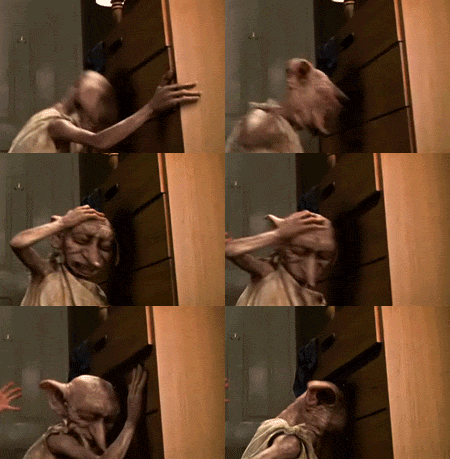
 I call it "The Dobby Complex."            


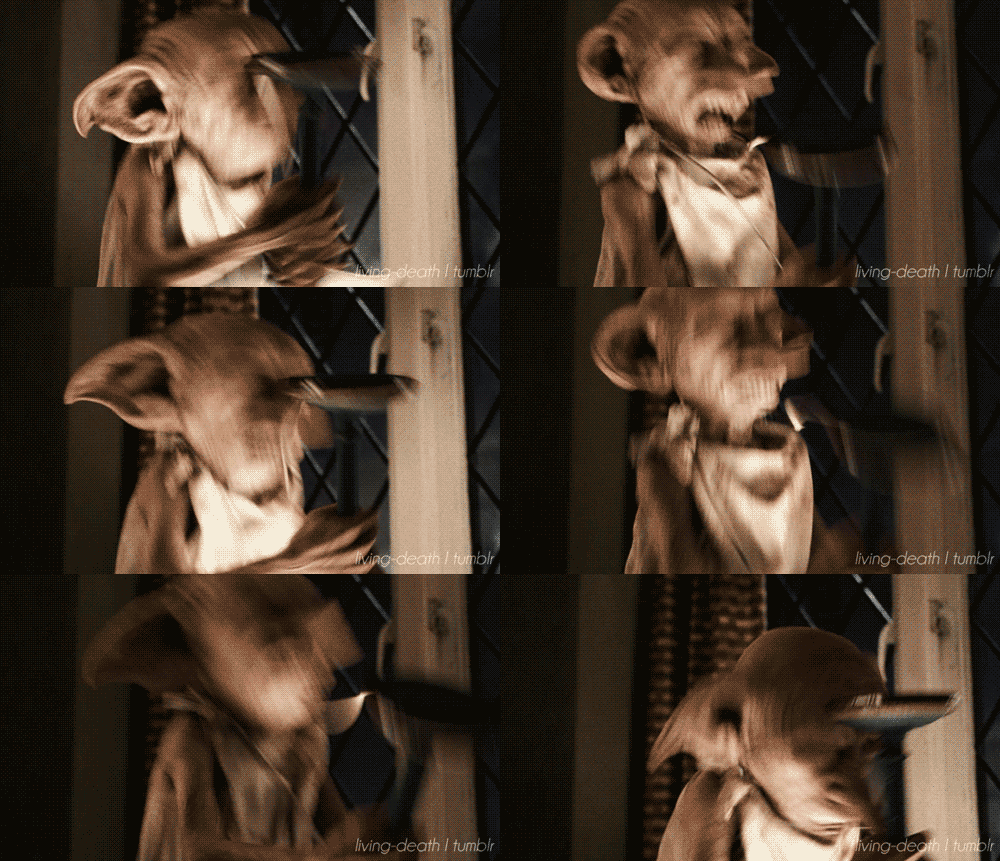
For those of you uncultured individuals who are not aware of my friend Dobby, go pick up a Harry Potter book and educate yourselves. I implore you. But in the meantime I suppose I'll explain: Dobby is a house-elf (think slave) for the tyrannical Malfoy family, who constantly mistreat him and cause him to doubt everything that he does. He always believes he makes mistakes, and when this happens, he punishes himself—usually in a very painful and ridiculous manner.

I have come to compare this lovable though mentally deranged character to a certain type of behavior I witness around me on an almost daily basis in college: the unhealthy obsession with perfection. You know those kids in your high school who excelled at everything? The perfect 4.0, scholarship-grabbing, overly-involved, gleaming embodiments of "success?" Those are my classmates. Because I attend a highly competitive university, I take classes with, befriend, and live among these kinds of people—because they're basically the only ones who get accepted. But we can't all continue to be "the best" in such an environment, which means that the risk of failure is always lurking behind every decision, every test, and every opportunity in front of us. And when failure inevitably occurs, a lot of these people don't know how to deal with it. They get a C on their economics test and then they're like "DOBBY MUST IRON HIS HANDS" as they rend their dirty pillowcase togas and run away in shame.

Now, this intense self-deprecation I'm surrounded by typically doesn't occur in a physical sense, like with Dobby. For the most part, these battles are fought within the confines of our minds, are felt in the pits of our stomachs—that nagging, sinking feeling of failure that tells you that you're not good enough. That your worth is purely dependent upon getting an A, cultivating a blossoming social life, or having the perfect body. When you're used to succeeding and everyone around you appears to be, it's almost too easy to be hard on yourself when you mess up. It's almost too easy to get upset and nitpick any and every aspect of yourself. And the more you think this way, the more you come to believe that there is something inherently wrong with you that is preventing you from being the epitome of perfection.

It's not a fun way to live.

I've always been a perfectionist in just about every aspect of my life. Those who know me well can attest to this. Throughout the years, no matter how great life seemed to be, I always found something to be pessimistic and upset about. I would be so hard on myself when there really was so much to celebrate.....and I still feel this way sometimes. I get down on myself when I get a B on a paper (I know, I'm insane), when I sleep in on the weekends (because I always feel like I'm wasting precious time), and when I procrastinate AGAIN and end up staying awake until 2 in the morning to finish an assignment that could have easily been taken care of hours earlier. I always feel that I need to be a better person, and I always turn into Dobby in these moments.

But you know what? You can't be perfect. NONE of us can be or ever will be during our lives. Yes, we can improve, and we SHOULD try to improve, but before we attempt to we need to accept the fact that we won't reach perfection. We can get close, maybe, but we simply can't. And once we remember that, and truly believe that, then we can attempt to progress and better ourselves in a healthy way instead of living under constant stress and the fear of failure. 

And honestly, I've gotten better at dealing with this while I've been here. I've succeeded and failed and learned from all of it. And ironically, failing has helped me become a better person. I've come to realize that we really shouldn't be so scared of failure.

It's all about the way you choose to deal with it.

So let's try to keep Dobby more a part of fiction and less a part of our realities. 

...I think we'll all be a lot happier that way.

10.28.2013

ON TECHNOLOGY AND GRANDCHILDREN...AND FEELINGS. AND OTHER POSSIBLY IMPORTANT THINGS

Recently I've found myself dwelling on the future, which, although not an unusual pastime for me, has turned into a vastly different train of thought. (I also have to say that I've been dwelling on my disgraceful lack of writing on this blog, and how LAME I feel because of that. Anyways.)

I've been thinking about how all of the technology that has infused itself into our society is going to effect our posterity. I mean, think about it! With the videos and photographs and blogs and social media outlets that we inhabit with every insignificant detail of our lives, our children and grandchildren are going to be able to see us and understand us in our young ages in a way that we never were able to with our grandparents...and even our parents. My grandchildren will be able to see multiple, if not thousands of pictures of me as a young adult and, should Facebook ever be made archival, how I interacted with my friends. And then there's me, with all I know about my grandparents at my age contained within a few old faded photographs and handwritten letters or journals that leave me wishing that I had a better idea of what they were like way back when.

And I thought about how incredible it will be for my progeny to have so much access and insight into who I am RIGHT NOW when I'm old and wrinkly and retelling the same stories over and over again while they pretend to love me and don't bother to hide the rolling of their eyes because I can no longer see anything...yeah...I promise I'm not bitter about growing up...

But anyways, the point is that I was viewing this in a completely positive light...until today. A couple whom I am somewhat acquainted with recently got engaged, and a video of the guy proposing was uploaded to Facebook. A video. It was taken by someone hiding in a bush or some other form of shrubbery who was obviously set up by the guy getting down on one knee. It was really far away, it was blurry, and you couldn't hear a single thing except for the heavy breathing and stifled fits of happy laughter from the person behind the camera. I've been aware that the whole "sneaky picture of the girl's reaction to the proposal" has become a fad recently, but now...a video? Really?

The existence of this video got me dwelling on the irony of our excess usage of technology. Yes, we have a lot of technology, but does that mean that we have to use it? We're pressured to think that we need to record everything in our lives now with these tools, but I can't help but ask, can't some things be private? Can't some events and aspects of our lives be personal and not out in the public domain for everyone to see? I believe there's something incredibly romantic about the idea that when I'm proposed to someday, it'll be just between me and the man I'm planning to spend the rest of my life with- a moment that only the two of us will experience, and no one else will ever see. I think that things like this should be intimate and personal and kept between those who are actually involved instead of projected to the world of social media for all of the nosy, snooping people (who believe that they're entitled to know everything about your life because you have a Facebook account) to witness.

And is it really important that we capture that moment on video? Do your children really need to see a blurry video with no sound in order to believe that you were actually proposed to? I mean, I've never seen videos of my parents and grandparents from back then and I'm still comfortable believing that they got married! Are we really going to sit around with our kids someday and say, "This was a selfie that I took before a football game one time. Oh, and this was a selfie that I took the next day driving to work. Ah, those were the days, kids. And you can tell how cool I was by how much of my lip is protruding from my duck face." 

Yes, our posterity is going to have a lot more access to our lives now because of technology, but...how much does it really matter? 

Although I honestly do think it's cool that we'll have more stuff to show our children, there's something to be said about the magic of storytelling and imagining. I know that someday I'd rather sit my daughters down and tell them the story of how I was proposed to, complete with vivid descriptions and details of what I remember from that moment and how I was feeling than show them fifty almost-identical shots of my reaction and a low-quality video taken by a hired roommate creeping in a bush. I'd rather have them create a glorious image in their respective minds of what it was like, even if it's completely off, because then that memory will be their own. Something beautiful is lost in absolutes. Recording absolutely everything leaves little to the imagination, and the imagination is so important.

I mean, that's the reason why there aren't pictures in novels, right? An author provides us with rich descriptions and details, and from mere words on a page we construct appearances and landscapes that are so real that we get all hot and bothered when a movie based on the book comes out and it doesn't look exactly how we pictured it. Because we LIVED it. Authors know that allowing us to create an image in our heads makes it so much more real to us than saying "there once was a young boy named Harry Potter and here are thirty actual pictures of him at different angles so you know exactly what he looked like and as you can see his scar is exactly one-and-a-half inches long and at a 45 degree angle right above his right eye, which is actually a lot less green than you'd imagine it to be."

Yeah. That would have tanked.

So I guess what this all boils down to is the fact that I'm scared about what all of this technology is doing to us and what it will do to our children's children who at some point will, like me, want to know more about their grandparents. Some of the prospects really do seem amazing, and I'm excited for them to know so much more about me than I did about mine, but...I hope that our obsession with preserving moments and images doesn't interfere with truly experiencing life ourselves. It can be fun, and it's definitely revolutionary, but how much of our drive to document is for nostalgia's sake and how much of it comes from our desire to go home and post it on Facebook to see how much attention it gets? 

It's worth thinking about.

When I get engaged someday (in the far, far distant future...which is, like, very far away), I want to know that my husband cares more about me and the very personal and special moment in which he asks me to be his forever than making sure he gets my reaction on camera so that all of his Facebook friends can experience it later...right along with me. It will be a moment meant for two people that won't be witnessed by hundreds of others, and it will be perfect for that very reason.

I just think that we could all do for a little bit of privacy in this overwhelmingly public world.

...I sincerely hope I'm not the only one.

7.24.2013

THE SEATING CHART EPIPHANY

I don't know why this happens to me, but it does, so I suppose I'm just going to accept it and write about it and stuff. What I'm referring to is my apparent propensity to have really deep thoughts (or so I think) spurred by random, mundane things in everyday situations where normally my trains of thought should be somewhere along the lines of "which of my three essays should I start writing first?" or "did I actually eat anything today?" and then musing on the answers to those questions in a half-cognizant state.

But not in my English class last week. No, my mind just couldn't act normally for some reason. I was sitting there, about three minutes prior to the beginning of class, and while watching people file in, I noticed how even after only a few weeks into the term, they all sat in the same seats that they always do. And there are like, fifteen kids in my class in a classroom that could definitely fit quite a few more people in it. And yet...everyone sits in the same spot. Every time. 

When I came to college, I was like "YAY NO SEATING CHARTS EVER AGAIN YESSSS" and the little child inside of me did a happy dance and I sat all over the place wherever I dang well pleased. It was great. But I noticed, and still do, that people never sit in different spots even though they have the option to. Not usually, anyways. They sit in the same places day in and day out and when two hours have passed they pack everything up and probably go do the same things they always do every afternoon as they walk up the JFSB stairs and into the smothering heat of a Utahan July. It's weird.

Why do people have such a tendency to gravitate toward routines? Really, though. I mean, I understand why you'd want a sense of consistency in some aspects of your life, like an apartment to sleep in every night or, I don't know, a steady job or something, but would it kill you to change up the place you sit every day? Or walk a different way to class? Or order something at a restaurant that you've never had before? Really, would sitting in a seat even just behind where you normally sit drastically change your life in a negative way? Would it? Because I highly doubt that it would. In fact, I might go so far to even suggest that it might be a healthy course of action.

Because last time I checked, life should be interesting. And sitting in the same seat, day in and day out, might be an indicator of a need to switch up other aspects of your life as well.
  
Maybe. I don't know. I don't even know where I was going with this. So...just pretend that this never happened. Yeah. That's probably a good idea.

6.03.2013

A NECESSARY RANTING SESSION

Over the years I've come to accept the fact that quite a few things in the world are always just going to be the way that they are and will never, ever change. For example, how the number of hot dogs and hot dog buns contained in a single package will never match up, or how when I introduce myself to people and say that I'm from Oregon they will always respond by either referencing rain, pot, trees, or some clever variation of the three. It's just the way it is. And I'm okay with that.

Except for one thing. It came to my attention once again this morning in my drawing class and I ALMOST exploded on everyone. Almost. What could possibly get under my skin so much? Well...actually, a lot of things. A lot of things do. But, in particular:

The way people give compliments.

Now before you think I'm even more rude and sarcastic than you probably already do, let me explain myself. It seems that the great majority of people can't give a compliment without putting themselves down in the process. And it's STUPID. I see it everywhere, but typically in anything remotely art-related, and especially when it comes to drawing. 

We were beginning to work on our self portraits (which for me meant pretending to find a picture of myself to use on my laptop during the whole class while actually doing a whole bucket of nothing) and a girl in my class quickly started sketching out some amazing renditions of herself. They were freakishly accurate--but I wasn't surprised because she's a brilliant artist. And that's awesome. But, of course, all I heard for the ENTIRE THREE HOUR CLASS PERIOD were people saying things like "I wish I could draw like that" or "Yours is already better in ten minutes than mine will be after I spend all weekend on it" or "I might as well chop off my hands or die tragically or go cry in the figurative corner of the art world for the rest of my life because I will never be able to draw like that...You're so talented!"

Is this supposed to be flattering? Do people really think that by saying how horrible they are in relation to someone, they're giving a good compliment? Because honestly, it's a really suckish thing to do. And it should stop.

Having been on the receiving end of "compliments" like this, I can say from experience that it's awkward. Because you're sitting there and someone says something along the lines of "I'll never be as good of an artist as you. All I can do are stick figures!" (followed by a forced chuckle like they're the first person who's ever said that) and then you have to decide how to respond. And when people say things like this to me I never know whether I should say thank you or apologize to them. It's really quite uncomfortable. Like, should I feel bad about the fact that I have that ability? Should I feel happy because they hate themselves? Should I look into the noble art of witchcraft and find a sort of spell or potion that will somehow magically transfer my talents to them so they can stop bringing up their inferiority during every waking moment?

I just don't know. But do you know what they don't know? How to give a compliment.

Why can't we just appreciate the amazing things that our friends and peers do without comparing or putting ourselves down in the process? Isn't it possible to walk into an art museum and admire a beautiful painting and be glad that the painter had that ability without thinking "HE IS SUCH A BETTER PAINTER THAN I COULD EVER HOPE TO BE MY LIFE IS A LIE" and walking out of the exhibit feeling like a piece of trash? I feel like it should be. 

The same thing goes with girls on Facebook. This is what the typical comment thread looks like on almost any picture of a girl: 
                                                                   
                                                                                            
So yeah. It needs to stop. Because the only part you play in a true compliment is the fact that you're saying it. Is it really so hard to genuinely appreciate someone's abilities, accomplishments, or appearance and just tell them that? Is it so hard to say "You know, you're an amazing artist. I am honored to know you and can't wait to see where you end up-- because it'll be somewhere awesome." IS IT? NO. NO IT IS NOT. So please, stop criticizing yourself when you attempt to compliment someone else. If the opportunity to be a more tactful person doesn't sway you to do so, do it for my sanity......

Because OH MY GOODNESS I wish I was as sane as you are! Like, I should, like, be in an asylum or something--I am just so crazy and dumb! But you're not! And that is, like...so awesome.

5.16.2013

MODESTY: WHY IT'S A GOOD IDEA

So it's getting hot out again. And by hot, I mean it's not snowing. Because let's just face it, "hot" for me is something drastically different than it is for...say, a tribe of people chilling on the equator. Ha. Chilling. And normally, this type of weather brings me buckets of discomfort for one of two reasons:

1. Really hot weather means sweat happens. And sweat is gross. 

2. A growing number of girls apparently believe that the sun uncovering itself is an invitation for them to do the same...which means that they basically walk out of the house without clothes on. Now that's hot, folks.

Except for not at all.

So while I'm on the subject, I thought I'd share some of my thoughts on the matter...because I have lots of feelings. And hopefully some insight on the whole modesty thing. 

Growing up, I was taught to dress modestly. What does that mean, you ask? That means that I don't put my body on display: my shirts are never too low, my skirts come to my knees, and I don't feel some unspoken urge to present my navel to the entirety of society on a daily basis. Hard to believe, I know. At first I went along with "being modest" because that's how I was raised, and because I never found it an issue to do so. As I grew older friends would sometimes comment on how "restricted" I must feel, how it must be horrible to "have to follow" such a rule, and how deprived I am from "being free" and "living my life."

First of all, wut? *checks breathing* Yep, still living, guys. Second of all, no one is forcing me to do anything. And lastly, I have realized over the years that respecting yourself by dressing modestly actually gives you a lot more freedom in every aspect of your life than the alternative. Loads more. But for specificity's sake, I'm going to talk about it in the particular vein of what I think is one of the biggest ironies in society. Ahem:

Women always complain about being objectified by men. All. The. Time. Seriously. A typical conversation with one goes something like this:

"Hey Emily, what's up?""Not much! Just going to get some groceries and swing by the bookstore an-OH MY GOODNESS WHY IS EVERYONE SO SEXIST I AM SUCH A VICTIM RANT CRY RANT."

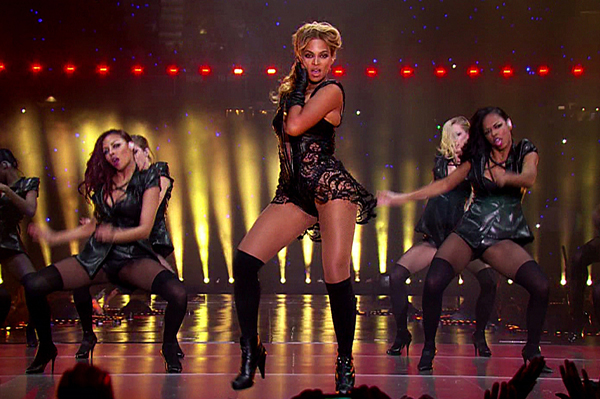
And they do this while worshiping popular female performers-- performers who prance around their respective stages belting out anthems about how independent and powerful they are all while wearing ridiculously revealing outfits and dancing super suggestively...and therefore objectifying themselves in the process. It makes absolutely no sense at all. The irony of this is blatantly obvious and yet people still don't see it. They sit on their couches watching them girate across the television screen while shouting something along the lines of "You GO girl!" and snapping in a Z formation or pumping their fists along to the over-processed, thumping beat and then an hour later they're like "Argh! Why men objectify me?! I am strong woman!"

And I want to laugh, but it's actually pretty sad. So I don't.

Really though. Like, it's almost entertaining when women talk about how guys are all disgusting pigs who only want them for their bodies. They get together and sassily discuss how they'll never find a "good man" because the guys they meet are less interested in their brains and personalities than...other parts of them. But the thing is, these are the same women who wear extremely low cut, plunging necklines or otherwise revealing clothing to places like the grocery store...or their grandfather's funeral. And they do it because they're FREE and INDEPENDENT and PROUD of their bodies. And they can do what they want, because FEMINISM.

And then they wonder why the guys who pursue them are complete bags of trash. Um...did you ever consider the fact that exposing yourself might be the equivalent to filling the trough for all of the creepy, pervy pigs in the world? Because it is.

And that's where modesty comes in. When you're tastefully dressing yourself, what are people naturally going to focus on? Your face, that's what. And the things associated with it-- like your personality...and your thoughts and ideas...and basically everything that makes you who you are. That's where their attention should go. When you're treating your body with respect, you'll attract guys who treat you with respect. Simple as that. 

And if you think you won't be as "attractive" by covering up, I'll leave you with the words of my lovely, close personal friend Ms. Emma Watson (a woman whom many men find very, very attractive):

“I find the whole concept of being ‘sexy’ embarrassing and confusing...I know everyone wants a picture of me in a mini-skirt. But that’s not me. I feel uncomfortable. I’d never go out in a mini-skirt. It’s nothing to do with protecting the Hermione image. I wouldn’t do that. Personally, I don’t actually think it’s even that sexy. What’s sexy about saying, ‘I’m here with my boobs out and a short skirt, have a look at everything I’ve got?’ My idea of sexy is that less is more. The less you reveal the more people can wonder.” 

So, yeah. Modesty. It's a good idea.